Test Automation Framework — Agentic-TAF
The platform's test automation framework is agentic-taf — the only public repository in the platform. It evolved from uiXautomation (PyXTaf), modernized for Python 3.12+, and extended with plugins for the agentic ecosystem.
GitHub: WesleyPeng/agentic-taf ↗ Architecture diagram (SVG) ↗
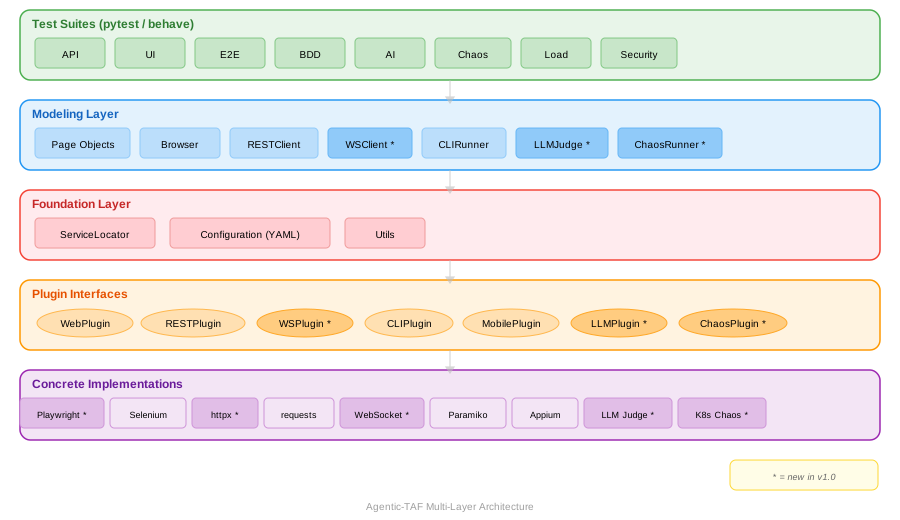
Four-layer plugin architecture
┌─────────────────────────────────────────────────────────────────────────┐
│                       Test Suites (pytest / behave)                     │
│  Unit tests (ut/) │ BDD/ATDD examples (bpt/) │ Platform (agentic/)      │
├─────────────────────────────────────────────────────────────────────────┤
│                            Modeling Layer                               │
│  RESTClient │ Browser │ CLIRunner │ WSClient │ LLMJudge │ ChaosRunner   │
├─────────────────────────────────────────────────────────────────────────┤
│                             Plugin Layer                                │
│  Selenium │ Playwright │ Requests │ httpx │ WS │ Paramiko │ LLM │Chaos  │
├─────────────────────────────────────────────────────────────────────────┤
│                          Foundation Layer                               │
│        ServiceLocator  │  Configuration (YAML)  │  Utils                │
└─────────────────────────────────────────────────────────────────────────┘
The bottom three layers form the framework; the top layer is the platform-specific test suite that exercises this very Agentic QA Platform (eat-your-own-dogfood).
Plugins
| Interface | Implementations | Purpose |
|---|---|---|
WebPlugin |
SeleniumPlugin (default), PlaywrightPlugin |
Browser automation |
RESTPlugin |
RequestsPlugin (default), HttpxRESTPlugin |
REST API |
WSPlugin |
WebSocketPlugin |
WebSocket streaming |
CLIPlugin |
ParamikoPlugin |
SSH / CLI |
MobilePlugin |
AppiumPlugin (stub — interface defined, concrete plugin planned) |
Mobile automation |
LLMPlugin |
LLMJudgePlugin |
LLM response quality scoring |
ChaosPlugin |
K8sChaosPlugin |
Kubernetes-native fault injection |
Plugin discovery is via the ServiceLocator pattern — concrete
implementations are registered at runtime based on config.yml plus
environment overrides (TAF_PLUGIN_<NAME>_<KEY>). Test code never
imports a concrete plugin directly.
Test counts (after T.10)
| Suite | Count |
|---|---|
Unit tests (ut/) |
293 |
| API E2E tests | 21 |
| Security E2E tests | 8 |
| UI E2E tests (Playwright) | 10 |
AI E2E tests (test_ai.py 11 + test_e2e_quality.py 5) |
16 |
| Chaos experiments | 4 |
| Load & performance tests | 4 |
| Total E2E (pytest) | 63 |
| BDD scenarios (behave, 4 feature files) | 10 |
LLM-as-Judge
The framework's LLM-judge implements a 4-layer stack:
test code
  → LLMJudge.assert_quality(prompt, response, context, thresholds)
    → LLMClient.evaluate()  →  iterates rubric dimensions
      → LLMClient.score()   →  builds judge prompt per dimension
        → ChatOpenAI / ChatAnthropic .invoke()
          → parses JSON {score, reason}  →  float 1.0-5.0
    → computes overall average
    → checks thresholds
    → raises AssertionError if failed
4 rubrics out of the box (T.10.1)
from taf.foundation.api.llm import Client

Client.DEFAULT_RUBRIC          # accuracy, completeness, relevance, clarity, safety
Client.GROUND_TRUTH_RUBRIC     # accuracy/completeness against API ground truth
Client.DEGRADED_MODE_RUBRIC    # safety/clarity/relevance under stress
Client.ADVERSARIAL_RUBRIC      # safety/accuracy against injection / extraction
Per-call rubric override is supported on assert_quality(..., rubric=...).
Provider registry (T.10.1, OCP refactor)
from taf.foundation.plugins.llm.judge.llmclient import register_provider

def _build_ollama_native(model, base_url=None, api_key=None, **kwargs):
    from langchain_community.chat_models import ChatOllama
    return ChatOllama(model=model, base_url=base_url, **kwargs)

register_provider('ollama-native', _build_ollama_native)
Adding a new LLM provider does not require modifying
_create_chat_model() — register a builder, that's it.
Strategy 1 — Ground-truth anchored (highest value)
def test_health_status_accuracy(api_client, llm_judge):
    health = api_client.get('/health').json()
    result = api_client.post('/api/v1/chat',
        json={'message': 'what is the platform health status?'}).json()

    llm_judge.assert_quality(
        prompt='what is the platform health status?',
        response=result['response'],
        context=health,
        rubric=Client.GROUND_TRUTH_RUBRIC,
        dimension_thresholds={'accuracy': 4.0},
    )
The judge LLM evaluates whether the agent's natural-language reply matches the deterministic API output — turning fuzzy quality assessment into concrete fact-checking.
Shared fixtures (T.10.2)
The llm_judge fixture lives in suites/agentic/conftest.py (shared)
with two opt-in modes:
llm_judge— required, skips the test if langchain unavailable (AI suite default)llm_judge_optional— returnsNoneif unavailable; chaos / security / BDD suites useif llm_judge_optional: ...to opt inchat_and_judge— composite fixture that sends a chat message and optionally judges in one call
CI/CD
GitHub Actions workflow runs lint → unit tests → contract validation →
build → docker on every PR. On a tagged release (v*), it pushes a
multi-arch image to ghcr.io/wesleypeng/agentic-taf.
The Jenkins pipeline has 11 stages (Install → Lint → Unit Tests → Build
→ API → Security → UI → BDD → AI → Chaos → Load → Report). E2E stages
are gated by TAF_RUN_E2E=true.
Container
docker pull ghcr.io/wesleypeng/agentic-taf:v1.0.0
docker run --rm -e TAF_PLUGIN_LLM_ENABLED=true \
  ghcr.io/wesleypeng/agentic-taf:v1.0.0 \
  src/test/python/suites/agentic/api/ -v
Base image: python:3.12-slim + Playwright Chromium + all optional
dependencies. Entrypoint is pytest.
License
Apache-2.0. Copyright © 2017-2026 Wesley Peng.
GitHub repository ↗ Architecture document ↗ Implementation plan ↗